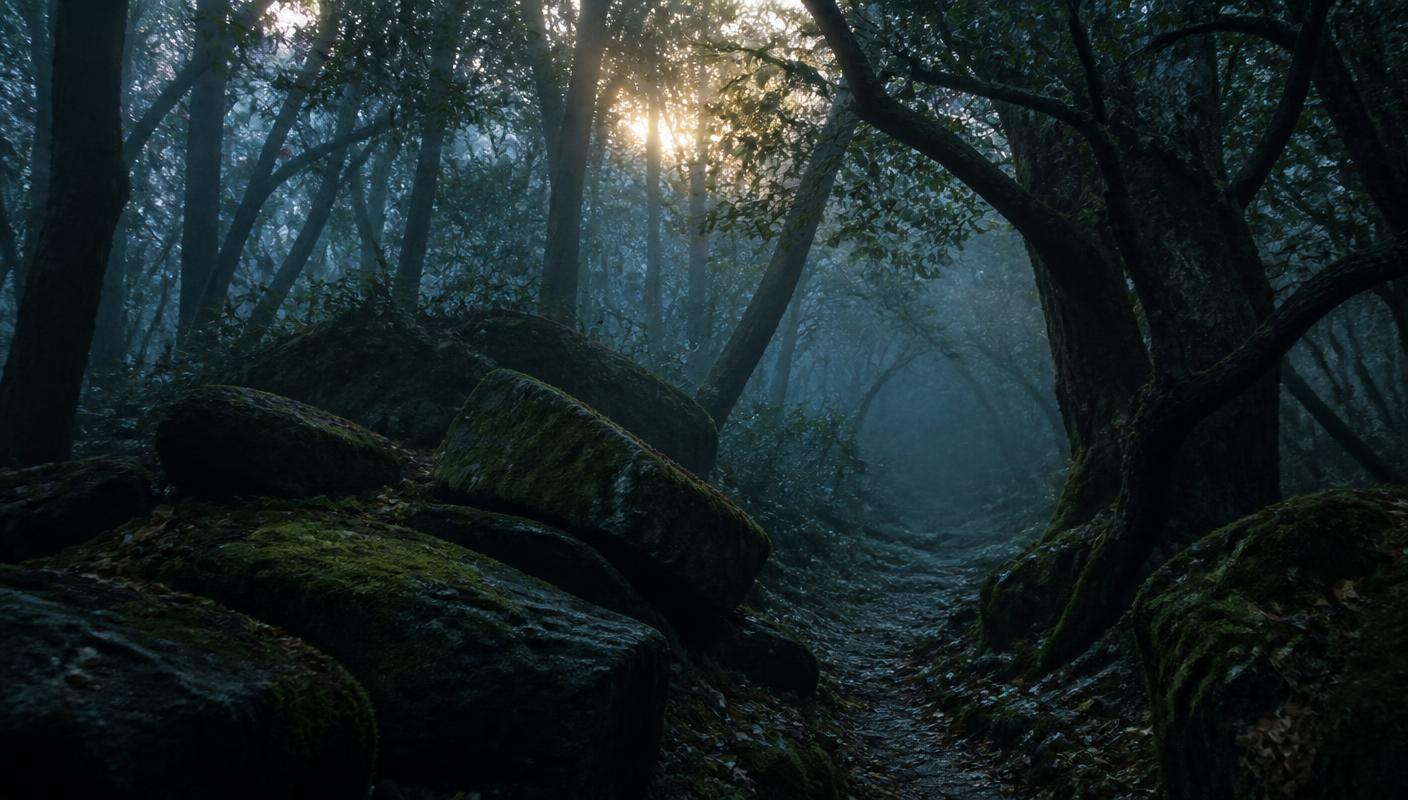
Appalachia is one of the oldest mountain ranges on earth, and it has been telling stories about itself for as long as people have lived in its hollers. What we call Appalachian folklore is a braid of three threads: Cherokee tradition that predates every settler by thousands of years, Scots-Irish and English ballads carried across an ocean, and West African practice brought here in bondage. They tangled together in isolated valleys where the nearest doctor was two ridges away, and what came out the other side was a way of living with the woods rather than against them.
These stories were never entertainment alone. They were instruction. A tale about a creature in the laurel thicket taught children which thickets to stay out of. A charm sewn into a coat lining gave a mother something to do with a fear she could not otherwise put down. The mountains were beautiful and they were dangerous, and folklore was the tool people used to hold both of those truths at once.
What follows is a short guide: three legends rooted in these woods, and four old protection practices you can still do tonight with things you already have.
Three Legends Rooted in These Woods
Every one of these stories is tied to a real place you could drive to. That is what separates mountain folklore from fairy tale — it always has an address.
The Moon-eyed People
Western North Carolina
Cherokee accounts tell of a pale, small-statured people who lived in these mountains before anyone else — folk who could not bear daylight and moved only under the moon. They are said to have built the low stone walls that still surface on ridgelines in Cherokee County, then vanished westward. Whether they were a memory of an earlier people or a story told to explain old stone, the shape of the tale is the same: the land was inhabited before us, and it kept some of its residents hidden.
The old ways honored what came before. A stone picked up on a walk is older than every story told about it.
The Wampus Cat
Tennessee & the Smokies
A woman wrapped herself in a mountain cat's skin to spy on a men's hunting ritual she was forbidden to see. She was caught, and the medicine man bound the skin to her forever — half woman, half cat, walking the hollers at night. Hunters still blame her for the scream that empties the woods of every other sound.
Nearly every mountain monster is a story about crossing a line. Ritual, in these hills, was as much about boundaries as it was about magic.
The Brown Mountain Lights
Burke County, North Carolina
For at least two centuries, people have watched pale orbs rise off Brown Mountain, hover, split, and go dark. Cherokee tradition holds they are the lanterns of women searching a battlefield for their dead. Settlers said a slave was searching for his lost master. Scientists have offered swamp gas, train lights, and refracted starlight — and none of it has made the lights stop appearing.
Some things in these woods stay unexplained. Folklore is what we build so we can live comfortably alongside a mystery.
Four Old Protection Rituals
Mountain protection work was plain and cheap. Nobody had a shop to buy supplies from, so the ingredients were whatever grew nearby: cedar, salt, quartz, running water, and the willingness to do a small thing on purpose. None of these require belief in anything. They require attention, which is harder.
Carry a found thing
The oldest mountain protection charm is something the woods handed you — a smooth creek stone, a piece of quartz, a knot of cedar. It was never bought. Pick it up on a walk you take deliberately, carry it in a pocket, and let it become the thing your hand reaches for when your mind runs hot.
Smoke at the threshold
Cedar and pine were burned at doorways to turn back what shouldn't come in. Light a small bundle, let it smolder, walk the doorway of the room you sleep in. The point isn't the smoke — it's the deliberate act of naming a boundary out loud in your own house.
Standing on the ground
Granny women prescribed bare feet on cold dirt for a racing heart long before anyone called it grounding. Step outside. Stand still for two minutes. Name five things you can hear. It costs nothing and it works more often than it has any right to.
Speak the name of what you're releasing
Write the worry on a scrap of paper. Burn it, bury it under a tree, or drop it in moving water. Mountain folk trusted running water to carry things off. The ritual gives a shapeless dread a shape, and then a destination.
On Talismans
A talisman is not powerful because of what it is made of. It is powerful because you decided it meant something, and then you kept it close. That is the whole mechanism — an old stone, a bit of copper, a name cut into wood. The mountains did not invent this. They just never stopped doing it.
Common Questions
What is Appalachian folk magic?
Often called granny magic or mountain magic, it is a practical folk tradition blending Scots-Irish, Cherokee, and West African practice. It leaned heavily on herbs, weather signs, water witching, and simple charms — knowledge held mostly by women and passed down by doing rather than by writing.
Are these rituals tied to a religion?
Not necessarily. Much of Appalachian folk practice sat comfortably alongside Christianity — the same granny woman who read signs in a cup would be in a pew on Sunday. You can practice any of the above regardless of what you believe.
What stones are used for protection in mountain tradition?
Quartz is the most common, partly because these mountains are full of it. Clear quartz turns up in creek beds all through the range, and a piece you found yourself was always considered stronger than one handed to you.
Is Appalachian folklore still practiced?
Yes. Foraging, weather-sign reading, herbal remedies, and small protective habits are still alive in mountain families, often without anyone calling it folklore. It just gets called the way we do things.
Keep walking the path.
Old practice works best on a rhythm. Here are three quiet places to start.
For more on working with lunar rhythm, read our guide to full moon and new moon rituals.