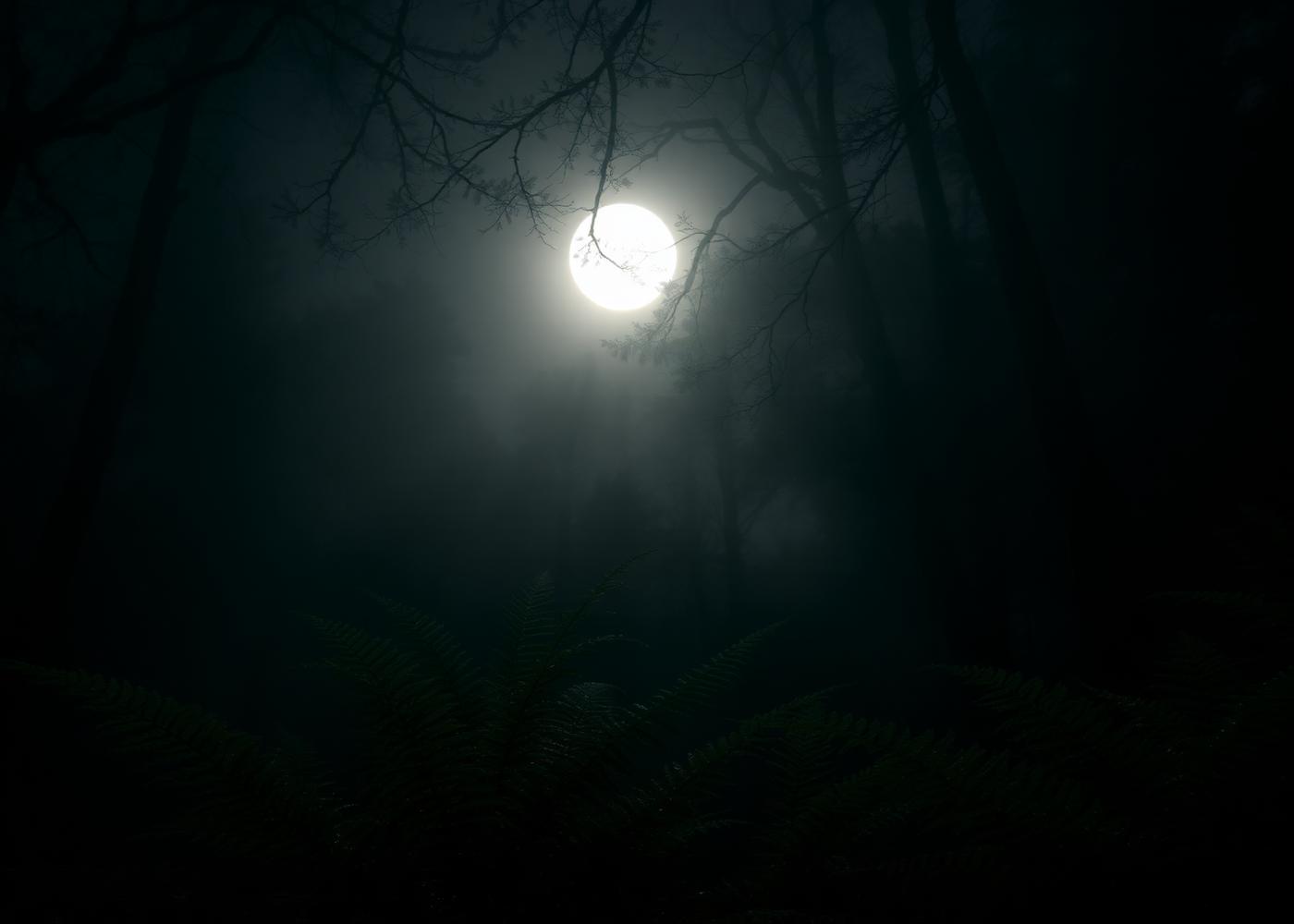
Twice a month the sky goes quiet. The moon slips up beside the sun, rises and sets with it, and for a night or two there is nothing to see at all. Most people call that emptiness. The old ways call it a beginning.
This is the first of eight field guides — one for each phase of the moon's monthly walk. And it starts where the cycle starts: with darkness.
What the new moon actually is
The moon doesn't disappear on a new moon — it's just hiding in plain sight. The moon gives off no light of its own; it only reflects the sun. During a new moon, the moon sits between the Earth and the sun, so the sunlit side faces away from us and we're looking at the dark back of the stage. The moon is up all day, right beside the sun, invisible against the bright sky.
That's why you can't see it, and why no amount of squinting will help. Astronomically, a new moon is a meeting — a conjunction — and it happens about every 29.5 days. (When the moon crosses directly in front of the sun at just the right distance, that meeting becomes a solar eclipse. Most months, it misses.)
What the new moon has always meant
Every tradition that kept time by the sky treated the new moon as the start of the month — and most of them still do. The Hebrew calendar, the Islamic calendar, the old agricultural almanacs: all begin their count in the dark.
The meaning that grew up around it is simple and consistent: the new moon is a seed. The field is empty, the light is gone, and nothing is visible yet — which is exactly when planting happens. You don't plant a seed in the harvest light. You tuck it into dark soil and trust what you can't see.
In Appalachian and older European farming lore, the new moon was for planting things that grow up — above-ground crops, new projects, new intentions. The waxing moon that follows was believed to pull growth upward with the rising waters. Whether or not the tides tug at turnip seeds, the logic of the practice holds: beginnings belong to the dark.
Working with the new moon
You don't need candles, crystals, or a perfect ritual. You need honesty and a piece of paper. But if you want the full practice, here it is, step by step:
- 1
Clear a small space.
A corner of a table is enough. The point is to tell yourself, physically, that this moment is different from the rest of the day.
- 2
Get quiet.
A minute of slow breathing. Feel your weight settle. The noise of the day sinks like sediment in a jar.
- 3
Name what you're beginning.
Write one to three things you want to grow this month. Phrase them as if they're already true: I am patient with my work. I welcome unexpected help. I tend my health with kindness. Be specific — vague wishes get vague results.
- 4
Say them out loud.
A whisper counts. This is the planting.
- 5
Tuck them away.
Fold the paper and put it somewhere safe — under a stone, in a journal, in a drawer with the things you keep. Let the dark hold it while it roots.
Then — and this is the part most people skip — rest. The new moon is not a call to action. It's permission to not yet see results. The growth of a seed is invisible for a long time before it isn't.
What the new moon is not for
Honesty is worth more than a tidy ritual, so here's what this phase isn't:
It's not for charging crystals or moon water.
There's no moonlight to charge anything with. That work belongs to the full moon, when the light is actually there.
It's not for big reveals or celebrations.
Nothing is ripe yet. The new moon rewards patience, not performance.
It's not unlucky.
The darkness gets a bad reputation, but every tradition that started its month here treated the dark as sacred, not sinister. Empty isn't wrong. Empty is ready.
A dark-sky field note
There's one practical gift the new moon gives that no other phase can: the darkest skies of the month. With no moonlight washing out the stars, a new-moon night is the best stargazing there is, even from a backyard. If you've never really looked at the sky, this is the night to start. The moon stepped aside so you could see everything else.
Want to know when the next new moon arrives?
The Moon Calendar marks every phase of the month ahead — and the rituals guide walks both the new and full moon ceremonies step by step.
Frequently asked questions
What does the new moon mean spiritually?
Beginnings. It's the seed phase of the lunar cycle — a time for setting intentions, starting quietly, and trusting growth you can't see yet.
Can you see the new moon?
No. The moon rises and sets with the sun and its lit side faces away from Earth, so it's invisible for a night or two. The thin crescent you can see a day or two later is the waxing crescent, not the new moon.
How long does the new moon last?
The exact alignment is a moment, but the moon looks dark for roughly one to three days around it.
What should you do on a new moon?
Something small and honest: clear a little space, write down what you want to grow this month, say it aloud, and put the paper somewhere safe. Rest counts too.
Is the new moon good luck?
Old farming and folk traditions treated it as the luckiest time to begin anything — plant, start, propose, launch. Luck in the old sense meant right timing, and the new moon was the right time to start.
When is the next new moon?
A new moon arrives about every 29.5 days. Our Moon Calendar shows the exact date and time for the current month.