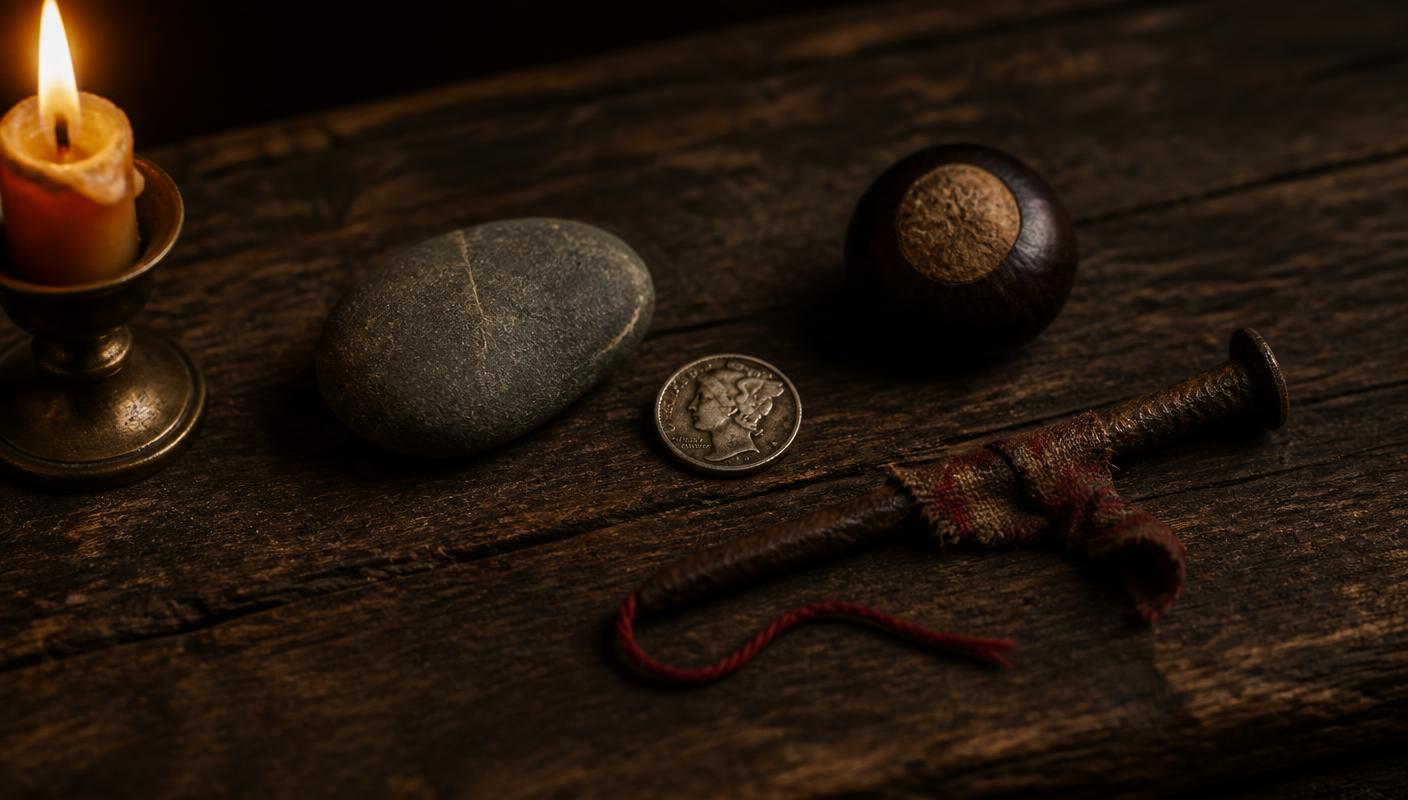
If you went through the pockets of a mountain grandmother a hundred years ago, you would not find much. A button, a folded prayer, a smooth stone that had no business being that smooth. None of it was bought at a shop. All of it was doing something.
Appalachian protection work was practical before it was mystical. The nearest doctor lived two ridges over, the nearest sheriff further, and the woods did not care whether you were having a good week. So people carried small things — not because the things were powerful, but because the carrying was. A charm gave you somewhere to put your hand when your mind started to race. It was a worry bead with a story attached.
Here is what they tended to carry, and what each was said to do.
The silver dime
A silver dollar was rare; a silver dime was not. Mountain folk kept a worn mercury or barber dime in a pocket or sewn into a hem, believing silver — real silver, not the nickel-clad sort — turned back ill will. Some would scratch a small cross into it with a nail. The belief was old enough that it crossed an ocean with the Scots-Irish, who had their own opinions about silver and iron and what should not cross your threshold.
If you carry one thing from this list, the old ones would vote for the dime. It is small, it is honest, and it ages well in a pocket.
A buckeye in the pocket
The buckeye — that smooth, dark nut of the Ohio buckeye tree — is the closest thing the eastern mountains have to a universal charm. Carrying one was said to ward off rheumatism, which was a reasonable fear if you spent your life on a mountainside in the wet. Gamblers kept one for luck. Granny women kept one because their mothers did.
You did not buy a buckeye. You found it in September when the husks split open, and you kept it until it dried and wrinkled, and then you found another. The finding was the point. A charm the woods handed you was always considered stronger than one you were given.
The rusty nail
This one surprises people. A bent or rusty iron nail, carried wrapped in a bit of red flannel, was kept to turn back the evil eye — the casual ill-wishing that mountain culture took seriously. Iron has a long, long reputation for breaking enchantment, older than these mountains. The nail did not need to be new. In fact, the older and more used, the better. It had already been through something.
A length of red thread
Red turns things back. Nearly every folk tradition on earth agrees on this one point, and Appalachia is no exception. A length of red thread tied around a wrist, or knotted nine times and dropped into a pocket, was a quiet ward. Mothers tied it to cradles. You will still see it — a red string on a baby's wrist in a mountain church, and nobody making a fuss about it, because it is just what you do.
The charm that needs nothing explained
The found stone
And here is the charm that needs nothing explained. A stone from a creek bed, smooth and cool and the color of nothing in particular, carried because your hand liked the weight of it. Mountain people did not overthink this one. You found it on a day you were walking somewhere on purpose. You put it in your pocket. It stayed.
A found stone is powerful precisely because nobody told you it was powerful. You decided it mattered, and then you kept it close, and that is the entire mechanism by which a talisman has ever worked.
How to carry one yourself
You do not need to drive to the mountains. The practice works the same anywhere:
Go for a walk on purpose.
Not to get anywhere. To look down.
Let something choose you.
It will be the third or fourth thing you notice, not the first. A stone, a coin you nearly stepped on, a piece of broken glass worn smooth by a gutter. The smoothness is what matters — the world has been working on it.
Keep it where your hand finds it.
A coat pocket. A pouch. The bottom of your bag.
Do not explain it to anyone.
The old ones never did. A charm with an audience is just jewelry.
The honest part
None of these objects do anything on their own. That is the unglamorous truth at the center of folk practice, and the old ones would have told you so. What they do is give you a place to put your attention when your attention needs putting somewhere. Your hand finds the stone. Your breathing slows. You remember that you are the kind of person who picks things up and keeps them, and that is no small thing to remember about yourself.
The mountains did not invent this. They just never stopped doing it.
Trail onward
If your pockets are empty these days, there are a few small things here that have been made to be carried — quietly engraved copper and steel pendants, meant to become that thing your hand reaches for. You will find them if you wander into the shop. No rush. The forest is not going anywhere.
A tool to keep the rhythm: mark the moon you walked under on the Moon Calendar, and keep what you found in your journal.
Common Questions
What did Appalachian people carry for protection?
A worn silver dime, a buckeye nut, a rusty nail wrapped in red flannel, a length of red thread, and — most commonly — a smooth stone found on a deliberate walk. None were bought; nearly all were found or repurposed.
What is a buckeye good for in folklore?
Traditionally, carrying a buckeye was said to ward off rheumatism and bring luck. More than any specific power, it was a found charm — something the woods handed you.
Does iron ward off evil?
Iron has a centuries-old reputation in European, Appalachian, and other folk traditions for breaking enchantment and turning back ill will. A bent or rusty nail was commonly kept for this purpose.
What makes a stone a talisman?
Not its mineral — your decision. A stone becomes a talisman when you find it on purpose, decide it means something, and keep it close. The carrying is the practice.