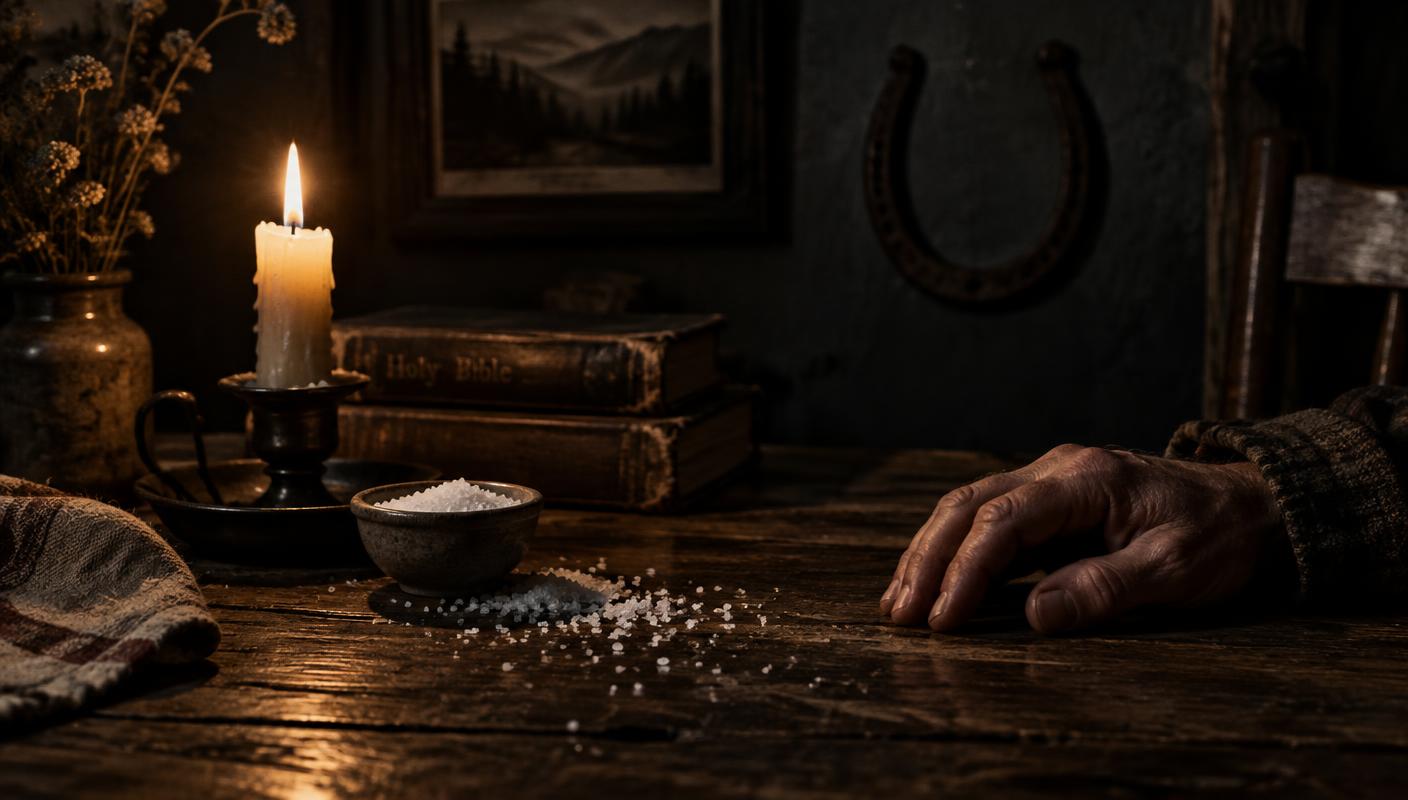
You do not believe in any of this. You have said so out loud. And then last Tuesday you said something hopeful about your health, and your knuckles went to the table before your brain caught up.
That is the thing about folk practice: it does not require your belief. It just requires your hands. Half the rituals we inherited survive not in grimoires but in reflexes — the little gestures we make automatically and then laugh about. Here's where a few of them actually came from, and why they refuse to die.
Knocking on wood
The most common superstition in the English-speaking world, and nobody agrees on where it started. The tidiest theory is pre-Christian northern Europe: spirits lived in trees, particularly oak, and you knocked to wake them, to thank them, or to make enough noise that anything ill-intentioned couldn't hear you bragging. A later version says you knocked to keep the fairies from overhearing your good fortune and deciding to even things out.
There's a simpler explanation I like better, and it isn't incompatible with the old one. Saying something hopeful out loud makes you feel exposed. Knocking gives that exposure somewhere to go — a full stop at the end of a sentence you were nervous to finish.
Throwing salt over your left shoulder
Salt was money. It preserved meat through winter, it was traded by the block, and spilling it was a genuine domestic catastrophe long before anyone called it unlucky. The superstition is what happens when a real loss gets a story wrapped around it.
The over-the-left-shoulder detail is medieval European: the devil, or whatever you'd like to call the thing that waits for you to slip up, stands at your left. A pinch of salt in the eye sends him off. People still do it — because the gesture converts an accident into a decision, and that feels better than sweeping up.
The horseshoe over the door
Iron, again. Iron shows up in nearly every European protection tradition as the thing that breaks enchantment, and a horseshoe is iron that has already done hard work and been shaped by fire. That combination — worked iron, hung at a threshold — is about as concentrated as folk protection gets.
The argument nobody has ever settled is which way up. Points up, and the shoe is a cup holding luck in. Points down, and the luck pours out over everyone who walks beneath. Both camps are certain. Both camps have grandmothers. Hang it whichever way your grandmother did; that lineage is doing more work than the orientation.
Wishing on things
Coins in fountains, eyelashes on a fingertip, the first star, birthday candles, 11:11 on a clock, the wishbone of a bird. Every one of these is the same mechanic: a moment is designated as brief and unrepeatable, and you're asked to say what you want inside it.
The magic is genuinely optional. The useful part is that most people go weeks without articulating a want, and a wish forces it into a sentence. Ask anyone what they wished for and watch how fast they know the answer. They'd been carrying it around all along.
The shorter ones
Black cats
Medieval Europe's scapegoat, tangled up with the witch trials. In Britain and Japan the same cat is good luck, which tells you everything about how sturdy these beliefs are.
Broken mirrors
Seven years, because Roman thinking held that life renewed in seven-year cycles and mirrors held a piece of your soul. Mirrors were also astonishingly expensive — once again, a real loss dressed in a story.
Umbrellas indoors
A Victorian one, and it may be as mundane as spring-loaded umbrellas being genuinely dangerous in a crowded parlor.
Walking under a ladder
Almost boringly practical — things fall off ladders — but the older reading is prettier. A ladder against a wall makes a triangle, and a triangle was read as a sacred shape you do not walk through.
Why any of this still works
None of these gestures change what's coming. What they do is give a body something to do with an unbearable feeling. Hope is uncomfortable; you knock. A mistake is unbearable; you throw the salt and move on. A threshold feels vulnerable; you hang the iron. These are not beliefs so much as interfaces — small physical actions attached to large unmanageable feelings, handed down because they work on the person, not the world.
That's why nobody has ever successfully argued someone out of knocking on wood. It was never an argument. It was a habit of keeping your hands busy while your heart does something difficult, and that is one of the more sensible things our ancestors left us.
So knock. Throw the salt. Say the thing out loud and then tap the table twice. Nobody's grading you.
Trail onward
If you'd like to carry one of these old habits somewhere quieter than a doorway, there are a few small engraved pieces here made to live in a pocket. They're in the shop, and they'll wait.
A tool to keep the rhythm: note the moon you were under when you made the wish on the Moon Calendar, and keep the rest in your journal.
Common Questions
Why do people knock on wood?
The oldest explanation is pre-Christian European belief that spirits lived in trees — you knocked to thank them, or to drown out your own boasting so nothing overheard it. Practically, it gives a nervous hope somewhere to go.
Why do you throw salt over your left shoulder?
Salt was valuable enough that spilling it was a real loss, and medieval belief put the devil at your left shoulder. A pinch in his eye turned an accident into a deliberate act of protection.
Which way should a horseshoe hang?
Points up holds luck in; points down pours it over the doorway. Both traditions are old and both are defended fiercely. The iron and the threshold are the parts that matter.
Are superstitions harmful?
Generally not. Most everyday superstitions function as small rituals that give anxiety a physical outlet — the gesture soothes the person rather than changing the outcome.